An Interview with Richard Johnson

How many people do you know who proclaimed to be “down for life” but drifted out of the scene a few years later? Richard Johnson is not one of them. Headbanger. Punk rocker. Journalist. Musician. All-around cool dude. Johnson is all of these and there’s no end in sight.
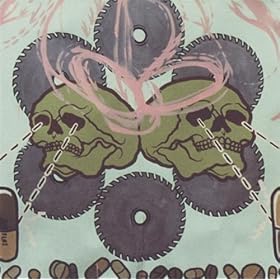
Johnson is the guitarist and vocalist for Virginia HC/grinders Drugs of Faith. He is best known as the guitarist from Enemy Soil and one of the three vocalists in Agoraphobic Nosebleed.
In addition to his career as a musician, Johnson edits and publishes the Disposable Underground fanzine, as he has for over 15 years. Disposable Underground is a fantastic resource for anyone interested in the recent history of modern metal and punk, with all issues available online.
Over the course of 39 issues, Johnson interviewed bands as wide ranging as Assuck, Letters to Cleo, Lynch Mob and Voivod. Some of Disposable Underground’s most fascinating interviews are with now-legendary underground bands like Nuclear Death and Discordance Axis.
When asked if he felt the gravity of interviewing such bands, Johnson said, “At the time, I just wanted to talk to them because I loved the music. I don’t remember doing any interview with a band that was legendary when I was doing them. I was just thinking, ‘It’ll be so great to put this interview in my zine because these people are gods.’ Either that or I was delighted that I got the chance to do the interview in the first place, but every zine editor must feel the same way about featuring a band they love in their publication.”
Throughout Disposable Underground’s existence, many trends have come and gone in the underground. Styles and subgenres like death metal, black metal, sXe revival, nu-metal, metalcore, screamo and many more have all had their day in the sun before being folded back under the metal/punk umbrella.
The death metal explosion of the early 90s was one of the first trends that threatened to burst into the mainstream and “destroy the underground.” This sense of dread over the 90s death metal glut was addressed repeatedly in issue 4-9 of D.U. Did Johnson think that death metal would pull through?
Johnson said, “I was beginning to doubt it. There was a popular trend of copying Suffocation and Cannibal Corpse. Things became very stale, like it is now with this fake thrash metal revival. Lots of magazines seem to be really into it, but it’s just a trend of copying an old scene.”
Is this phenomenon unique to underground rock music? According to Johnson, the answer is no.
He said, “It’s just like with certain strands of popular music. Put on some bellbottoms, buy some vintage equipment, tune your radio to the classic rock station and break the knob. Voilả! You’re a retro-rock band, but with an alternative twist!”

Johnson feels that this phenomenon, not just the death metal explosion but all of them, come and go in waves. Bands will come out of nowhere, copying the bands that everyone else is copying already, and not put any heart into it.
“Reading Choosing Death [by Albert Mudrian] brought back a lot of memories- there’s lots of discussion about this period of death metal,” Johnson said.
Many things have changed since the early 90s. Most notable among them is the rise of the internet. Johnson, like everyone else, has embraced the digital frontier, but still feels that there is a role for the printed fanzine in the 21st century.
Johnson said, “I’m happy that they’re still around. It seems that, with the spread of semi-affordable technology, zines have moved online. But there are still old-school people who go to Kinko’s (or some other copy service establishment) or do it on a copy machine. I try to straddle the two, print and online, with the website being a place where you can download the zine and print it out on your end, or read it online with a print-style layout. I’ve not been able to print the last few issues, unfortunately.”
Also unfortunate is the demise of the hand-written letter, which has been replaced in large part by the message board. In the early years of Disposable Underground, Johnson received numerous missives from bands angry with the reviews they received. Most notably (and amusingly, at least to me) was the back-and-forth exchange with Illinois death metal band Oppressor. Johnson chalks it up to immaturity and misguided, youthful enthusiasm on all sides.
Johnson said, “If the same scenario happened now, it might have turned out a different way or not happened at all. People are young when they start bands. I don’t want to single them [Oppressor] out anyway. I’ve gotten my fair share of hate mail over the years from plenty of other people.
“One bunch, I can’t remember who, [literally] shredded my zine, poured perfume all over it, and mailed it to me with pentagrams on the envelope. That was pretty good- it took a little bit of effort.
“I wrote another guy about some zine distribution. He was annoyed that someone who had Testament in his zine (in his eyes, they were ‘pussies’ or some such) was writing to him. There were some other guys who didn’t like that I had [former Headbanger’s Ball host] Riki Rachtman in my zine. They got a lot of public shit-talking mileage out of that one. There were plenty of others. All of these people were entitled to their opinions, of course.”
When pressed about the members of Oppressor and Broken Hope, who went on to form nu-metal band Soil, being the sort of people who ‘ruined’ the underground, Johnson offers a surprisingly mature response.
“I can’t remember what Soil sounds like, but bands are within their rights to move on to other pastures. I used to blame bands for ruining things, but it’s the bands who emulate them in drove who are the problem, probably. I’ve grown up a lot and I still need to grow up a lot. I’m more diplomatic and informative in my reviews than I used to be. If a band needs to be ripped to shreds in a review, then they deserve it, but not without explanation in the review and/or constructive criticism.”

Politics is another subject in metal and punk that can easily excite people. In the early issues of Disposable Underground, bands being interviewed would often be hit with a complex but ill-timed political question. Johnson rejects the notion that political questions were added to the interviews in an effort to mimic zines such as Maximum Rock and Roll.
“I can’t really say what Disposable Underground’s influences were, but Maximum Rock and Roll wasn’t one of them,” Johnson said. “The awkwardness can be chalked up to youth but, by that, I mean a lack of a natural flow to the Q&A’s. There wasn’t any attempt at blindsiding but, instead, a ham-fisted attempt at mixing up the questions.”
Politics isn’t new territory for Johnson. His 90s grind band Enemy Soil had highly political lyrics but didn’t forget how to rock. How did Johnson mix politics and grind seamlessly?
He said, “Lots of bands concentrate too much on their lyrics. In this kind of music, you can’t tell what the hell the band is saying without a lyric sheet anyway. To me, the lyrics accompany the music, not go before them, so the arrangement of the lyrics on the music is very important.
“You can tell that too much importance is put on lyrics by reading band interviews. It’s really boring to read interviews about a band’s lyrics when there’s nothing to talk about musically, or when the interviewer doesn’t understand music or doesn’t have the vocabulary to discuss it. You see that a lot in music reviews in mainstream magazines and on the radio. They don’t know what to say about the music, so the spend most of their time talking about the lyrics.”
With that said, what did Enemy Soil hope to accomplish during its existence?
“It’s a cliché, but we just wanted to do a demo,” Johnson said. “We had aspirations of ‘educating the masses,’ but that was a very early pipe dream by a bunch of stupid, white middle-class kids that were in desperate need of a reality check. When we got over that and tried to kick out some furious grindcore, while not straying away from the subject matter, it got a lot better.
“Honestly, I’m happy when someone simply tells me that they enjoy/enjoyed listening to Enemy Soil. I want whatever I do to be successful, but to hear that it makes someone else happy really makes my day. I’ve heard, over the years, from people who told me Enemy Soil was their favorite hardcore band or, less often, was an influence on their band. It’s a huge compliment.
Speaking of which, the band’s album “Casualties of Progress” was recently reissued through Relapse Records. What are all the new-jacks in the Houston area missing?
Johnson said, “Basically, it’s good for people who missed out on it the first time around. It’s also a trip back in time to 1994. It’s a primitive record, but it’s got that youthful balls-to-the-wall attitude that might be a fun listen for some people. Also, for those who bought the original, it’s remastered and has a fistful of bonus tracks, so it’s a good package. For those who can’t deal with vinyl [huh? - Ed.] it’s on CD. There’s a lot going for it, I think.”
Johnson is also a vocalist in Agoraphobic Nosebleed, a popular Relapse band that still releases EPs on DIY labels. Where does Johnson see Agoraphobic Nosebleed in the pantheon of heavy music?
“I don’t know. It depends on how you view the band: lyrically, musically or both” Johnson said.
“Lots of people have beef with the lyrical content, and I can’t blame them one bit, but that’s only one side of the content. The band has changed a lot since the demo. One of the reasons the band is so popular is because it’s on fucking Relapse and Relapse is pushing it. Lots of people love Agoraphobic Nosebleed and, if they were on a small label pressing 1000 of a 7” or LP each time, that’s totally cool and there’s nothing wrong with it at all, but a much smaller number of people would have heard it.

“Plus, royalties and advances mean better equipment and better recording equipment, which directly impacted the musical evolution of the band, which is only natural. That’s a very positive impact on ANb from being on a label of Relapse’s stature. Of course, the music has to be good. If the music wasn’t all that great, the band would have only gone so far given that kind of backing.”
Contact Richard Johnson at:
www.disposableunderground.com
www.drugsoffaith.com